|
Consumer Price Inflation (1) |
General Government Surplus (+) or Deficit (-) |
General Government Gross Debt |
Long-Term Interest Rate |
Exchange Rates Within the EMS |
All Criteria Fulfilled | |||
|
Normal Fluctuation Margins |
ERM Participation |
„Strict" Interpretation (2) |
Art. 104c(2) Interpretation (2) | |||||
|
% change |
% of GDP |
% of GDP |
% |
1995/96 |
1996 | |||
|
Belgium |
1.9 |
-2.7 |
126.7 |
5.8 |
yes |
yes |
no |
yes |
|
Denmark |
2.4 |
+0.3 |
67.2 |
6.2 |
yes |
yes |
no (4) |
yes (5) |
|
Germany |
1.8 |
-3.0 |
61.8 |
5.6 |
yes |
yes |
no |
yes |
|
Greece |
6.0 |
-4.9 |
108.3 |
10.8 |
no |
no |
no |
no |
|
Spain |
2.3 |
-3.0 |
68.1 |
6.6 |
yes |
yes |
no |
yes |
|
France |
1.6 |
-3.0 |
57.9 |
5.8 |
yes |
yes |
yes |
yes |
|
Ireland |
2.0 |
-1.0 |
68.3 |
6.4 |
yes |
yes |
no (4) |
yes |
|
Italy |
2.3 |
-3.2 |
122.4 |
7.0 |
no |
yes (3) |
no |
no/yes ? |
|
Luxem- |
1.7 |
+1.1 |
6.5 |
6.0 |
yes |
yes |
yes |
yes |
|
Nether- |
2.4 |
-2.3 |
76.2 |
5.6 |
yes |
yes |
no(4) |
yes |
|
Austria |
2.0 |
-3.0 |
68.8 |
5.6 |
yes |
yes |
no |
yes |
|
Portugal |
2.5 |
-3.0 |
64.1 |
6.5 |
yes |
yes |
no |
yes |
|
Finland |
0.9 |
-1.9 |
59.2 |
5.9 |
no |
yes (3) |
yes (4) |
yes |
|
Sweden |
0.7 |
-2.6 |
76.5 |
6.7 |
no |
no |
no |
no |
|
United Kindom |
2.2 |
-2.9 |
54.7 |
7.5 |
no |
no |
no |
no (5) |
|
EU-15 average |
2.1 |
-2.9 |
72.9 |
6.2 |
countries |
countries | ||
|
Reference value |
2.6 (*) |
-3.0 |
60.0 |
8.2 (+) |
3 |
10-11 (12) | ||
(1) Price inflation is evaluated according to the „harmonized" conumer price indices (CPI).
(2) Refers to the fiscal criteria (general government balance and general government gross debt) according to the EC Treaty, Art. 104c(2).
(3) Since October 12, 1996 Finland takes part in the exchange-rate mechanism of the EMS; Italy joined again on November 2, 1996.
(4) The Council (ECOFIN) decided on July 1996 that Denmark and Ireland met the fiscal criteria based on data of 1995 (no excessive deficit); Luxembourg always complied with this condition; on May 12, 1997 the Council decided that also the Netherlands and Finland (based on data of 1996) have no longer an excessive deficit.
(5) Denmark and the United Kingdom have an „opting out" rule (Protocol 11 and 12 of the EC Treaty).
(*) Defined as the average inflation rate of those three countries with the lowest inflation rates plus 1.5%.
(+) Defined as the average nominal long-term interest rate of those three countries with the lowest inflation rates plus 2 percentage points.
Convergence criteria according to the EC Treaty, Art. 109j and the Protocols 5 and 6.
EMS = European Monetary System; ERM = Exchange-rate mechanism of the EMS.
Source: European Commission, Spring 1997 forecasts.
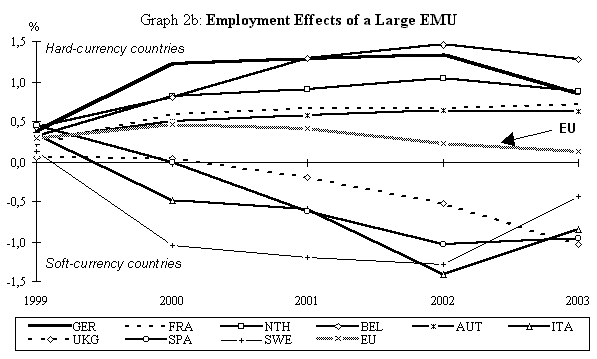
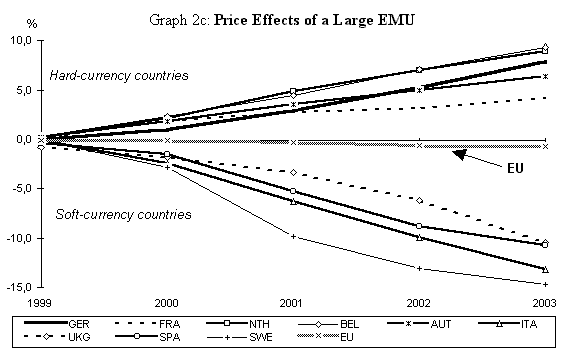
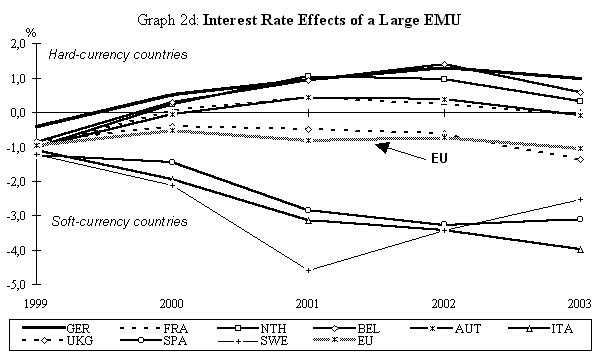
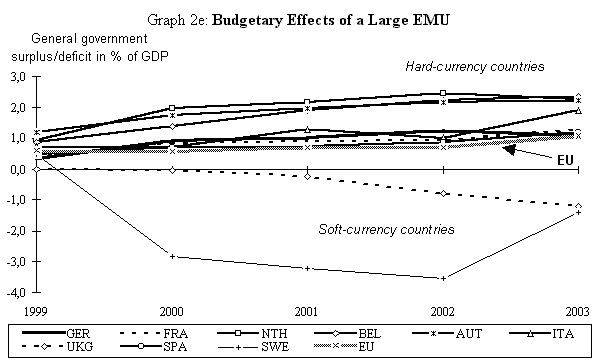
Economic Effects(model inputs) |
Positive Impact |
Negative Impact |
Reduction of transaction costs(0.2% to 0.9% of GDP; adjustment of disposable income - less in hard-currency countries, more in soft-currency countries) |
|
|
More competition in the financial sector(-1% short-term interest rates; evenly imputed for all countries) |
|
|
Exchange rate stability(imposition of the exchange-rate fluctuations of the period 1992-96 to the period 1999-2003) |
|
|
Dynamic or growth effects(increase of total factor productivity - TFP - by 0.3% to 0.7% according to the Baldwin multiplier) |
|
|
Partial effects of EMU |
Total Effects of EMU(5)=(1+2+3+4+5) | |||||||||
|
Reduction of Transaction Costs |
More Competition in the Fincancial Sector |
Exchange-rate Stability |
Dynamic or Growth Effects | |||||||
|
1st year |
5th year |
1st year |
5th year |
1st year |
5th year |
1st year |
5th year |
1st year |
5th year | |
|
(Deviations from base line solution(1) in %) | ||||||||||
GDP effects: |
||||||||||
|
HC |
0.25 |
0.12 |
0.31 |
0.18 |
0.28 |
0.16 |
0.13 |
1.46 |
0.97 |
1.92 |
|
AT |
0.45 |
0.00 |
0.36 |
0.25 |
0.06 |
0.30 |
0.21 |
1.64 |
1.08 |
2.19 |
|
SC |
0.72 |
0.24 |
0.38 |
0.60 |
-0.51 |
-1.97 |
0.18 |
2.54 |
0.77 |
1.41 |
|
EU |
0.44 |
0.17 |
0.34 |
0.35 |
-0.04 |
-0.70 |
0.15 |
1.89 |
0.89 |
1.71 |
Employment effects: |
||||||||||
|
HC |
0.09 |
0.11 |
0.12 |
0.17 |
0.08 |
0.21 |
0.04 |
0.34 |
0.33 |
0.83 |
|
AT |
0.13 |
0.09 |
0.10 |
0.21 |
0.02 |
0.22 |
0.04 |
0.11 |
0.29 |
0.63 |
|
SC |
0.23 |
0.44 |
0.11 |
0.57 |
-0.13 |
-2.15 |
0.03 |
0.24 |
0.24 |
-0.90 |
|
EU |
0.15 |
0.24 |
0.12 |
0.33 |
0.00 |
-0.74 |
0.03 |
0.30 |
0.30 |
0.13 |
Price effects: |
||||||||||
|
HC |
0.08 |
1.85 |
0.13 |
2.44 |
0.05 |
5.0 |
-0.13 |
-2.46 |
0.13 |
6.83 |
|
AT |
0.19 |
1.90 |
0.14 |
2.80 |
0.00 |
3.10 |
-0.07 |
-1.35 |
0.26 |
6.45 |
|
SC |
0.21 |
3.10 |
-0.13 |
2.82 |
-0.22 |
-15.17 |
-0.21 |
-2.56 |
-0.35 |
-11.81 |
|
EU |
0.13 |
2.35 |
0.02 |
2.60 |
-0.06 |
-3.12 |
-0.16 |
-2.50 |
-0.07 |
-0.67 |
Interest rate effects: |
||||||||||
|
HC |
0.20 |
0.78 |
-0.84 |
-0.36 |
0.11 |
2.19 |
-0.33 |
-2.27 |
-0.86 |
0.34 |
|
AT |
0.23 |
0.66 |
-0.93 |
-0.45 |
0.08 |
2.25 |
-0.38 |
-2.55 |
-1.00 |
-0.09 |
|
SC |
0.22 |
0.65 |
-0.89 |
-0.39 |
-0.02 |
-0.51 |
-0.41 |
-2.50 |
-1.10 |
-2.75 |
|
EU |
0.21 |
0.72 |
-0.86 |
-0.37 |
0.05 |
0.99 |
-0.36 |
-2.37 |
-0.96 |
-1.03 |
Budgetary effects: |
||||||||||
|
HC |
0.32 |
0.34 |
0.26 |
0.46 |
0.07 |
0.29 |
0.11 |
0.73 |
0.76 |
1.82 |
|
AT |
0.55 |
0.23 |
0.43 |
0.81 |
0.02 |
-0.01 |
0.18 |
1.18 |
1.18 |
2.21 |
|
SC |
0.26 |
0.36 |
0.22 |
0.63 |
-0.14 |
-1.81 |
0.10 |
0.92 |
0.44 |
0.10 |
|
EU |
0.29 |
0.35 |
0.24 |
0.54 |
-0.02 |
-0.64 |
0.10 |
0.82 |
0.61 |
1.07 |
|
Exchange rate |
||||||||||
|
(Euro/US-$)(2) |
0.01 |
1.83 |
0.27 |
2.61 |
-0.01 |
4.86 |
-0.01 |
-2.52 |
0.26 |
6.78 |
(1) Base line solution is the EMU scenario with fixed exchange rates vis-à-vis the DM, starting in January 1999. The scenario "Exchange-rate stability" compares the EMU scenario with a situation of exchange-rate fluctuations during the period 1992 to 1996. "Large EMU" means in the model, that 9 EU Member States participate in the EMU.
(2) An increase (decrease) means devalutaion (revaluation) of the Euro against the US-Dollar.
HC = Hard-currency group (Belgium, Germany, France, Netherlands, Austria).
SC = Soft-currency group (Spain, Italy, Sweden, United Kingdom).
AT = Austria; EU = HC + SC.
Source: Own calculations with the OEF World model.